MEMORY AND CONTEMPORANEITY. Traversing Art
Tools and methods for cultural policies
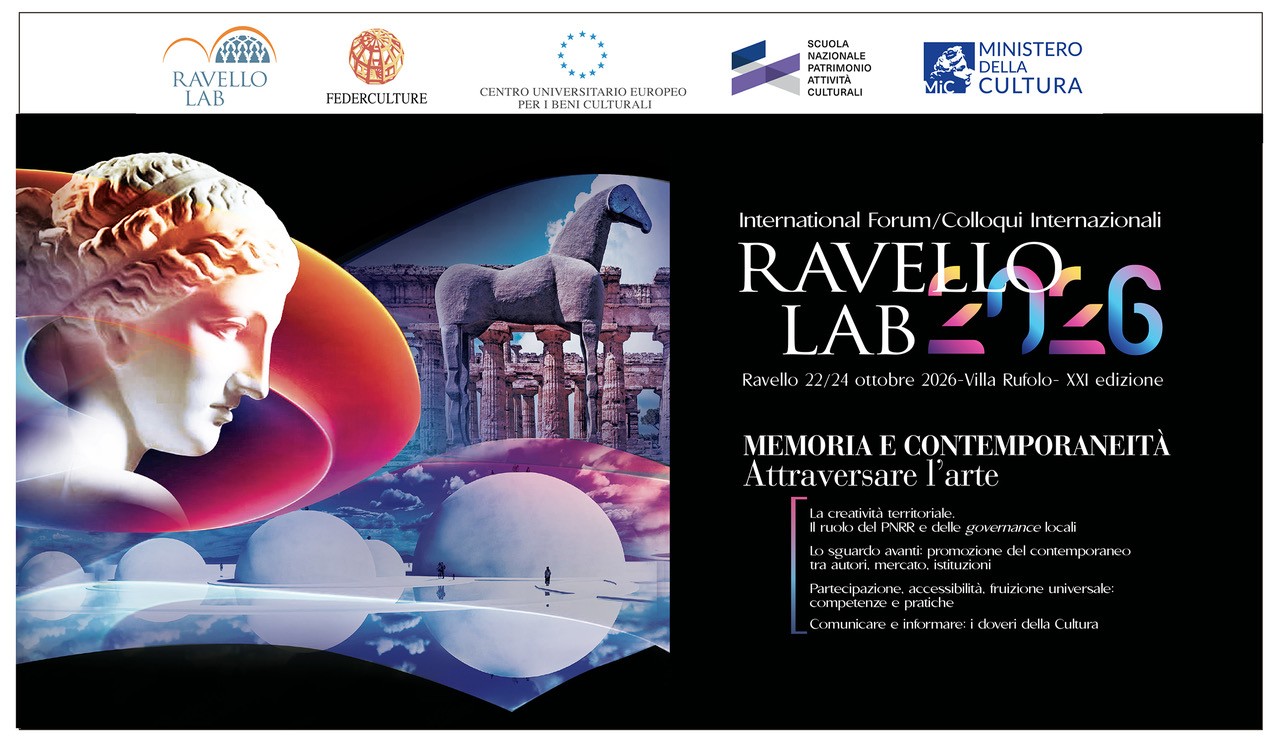
Ravello Lab – 21st Edition
- October 22–24, 2026
Federculture and the National School for Cultural Heritage and Activities
As it enters its third decade of activity, Ravello Lab proposes a discussion on contemporary art—specifically focusing on the need to maintain a vibrant dialogue between traditional cultural heritage and modernity. For over a century—and with increasing intensity in recent decades—insights and experiments in this field have flourished both abroad and in Italy, placing the country at the forefront of this movement. The numerous examples visible to all have consistently yielded mutual benefits; more importantly, the creativity of many great contemporary artists—strongly stimulated by this context—has produced excellent results and indisputable added value in terms of appeal and attractiveness. This has led to increased visitor numbers whenever museums, art galleries, and monumental complexes host temporary or permanent exhibitions—ranging from sculptures and paintings to installations located both indoors and outdoors. Building on these premises—and grounded in concrete data—the Ravello Lab 2026 community is invited to engage in a multi-perspective dialogue. The goal is to devise strategies and operational methods aimed primarily at young people—who require policies fostering a more informed engagement with art—as well as at disadvantaged groups, in accordance with constitutional principles of equality, solidarity, and social equity. Thus, the central theme of this edition—“Memory and Contemporaneity: Traversing Art”—is explored through various thematic panels. The approach is comprehensive, ranging from the regeneration of spaces to the National Recovery and Resilience Plan (PNRR) for Culture; from the tangible impact on local areas and the role of local decision-makers to the challenges of promoting contemporary art and the dynamics between artists, the market, and institutions; all while paying special attention to education, inclusion, and the concept of “access for all.” In the background lie Communication and Information, representing the sum of the duties Culture must fulfill to build the legacy of the future and foster a virtuous, creative dialogue with the past!
Program
The proceedings will begin on Thursday, October 22, with a lecture titled “Memories and Contemporaneity: Traversing Art,” delivered by Jacopo Veneziani—an art historian, lecturer at IULM University, and popularizer.
There will then be a brief presentation of the Italian Capital of Culture 2027, Pordenone
The proceedings of the first day will conclude with the award ceremony for the “Living Heritage 2026” prize.
The entire day of Friday, October 23, will be dedicated to panels that, in parallel sessions, will explore in depth topics related to the relationship between culture and development.
Panel 1
Territorial creativity. The role of the PNRR and local governance
Chair: Fabio Pollice, Full Professor of Economic Geography at the University of Salento
Panel 2
Looking Ahead: Promoting Contemporary Art Among Artists, the Market, and Institutions
Chair: Pierpaolo Forte, Professor of Administrative Law, University of Sannio
Panel 3
Participation, accessibility, universal use: skills and practices
Chair: Marcello Minuti, Coordinator of the National School for Cultural Heritage and Activities
Panel 4
Communicating and Informing: The Duties of Culture
Chair: Alberto Bonisoli, Director, Federculture Study Centre
On Saturday, October 24, following the presentation of the panel findings, the final round-table discussion will take place—moderated by LA7 journalist Flavia Fratello—featuring experts and representatives from local and national institutions who will delve into the theme of the 21st edition of Ravello Lab.

