International Conference “Culture Against Disasters”
Culture as a factor of development

The protection of cultural landscapes as a means of preventing natural disasters
- September 28–29, 2018
in collaboration with EUR-OPA Major Hazards (Council of Europe) | within the framework of the "IKMeFInd" project – European Year of Cultural Heritage
Should we protect cultural heritage from disasters, or make heritage preservation an act of disaster prevention? This is not a provocative question, but rather the theme of the international conference “Culture Against Disasters,” organized by the European University Centre for Cultural Heritage on September 28–29 in Ravello, within the magnificent setting of Villa Rufolo.
The conference—supported by the European and Mediterranean Major Hazards Agreement (EUR-OPA), a Council of Europe program aimed at reducing natural and man-made disasters—is based on observations that are as simple as they are rarely made. Cultural landscapes—such as terraces, traditional irrigation and cultivation systems, and the knowledge embodied in these structures—are not only part of a territory’s cultural heritage but also a record of “historic” transformations that have survived to the present day precisely because they have successfully withstood dozens of extreme natural events. Preserving them, therefore, helps prevent recurrent local natural disasters.
However, the agricultural activities that shape these cultural landscapes have generally become less profitable; this is due both to their high labor requirements and to the fact that the farms are almost invariably small-scale, which excludes them from many of the benefits of European Union agricultural policies. This decline in profitability leads to land abandonment, thereby increasing the risk of environmental instability.
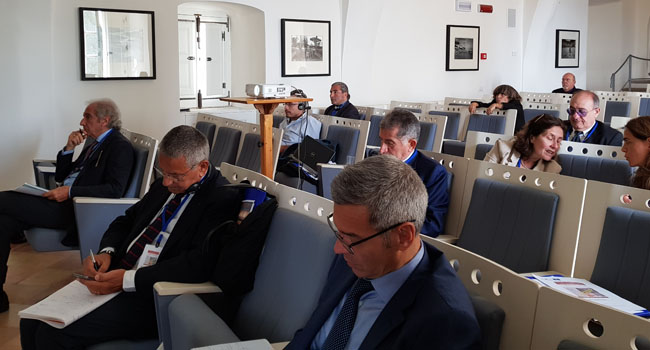
The Conference—attended by the Ministry of Agricultural, Food and Forestry Policies and Tourism, the Ministry of Cultural Heritage and Activities, the Civil Protection Department, the Campania Region’s Department of Agriculture, experts from research centers in Greece and Algeria, and representatives of Italian cultural landscapes (such as Cinque Terre and the Amalfi Coast)—sparked a vigorous debate. This discussion helped define potential measures to support agricultural businesses whose activities contribute to maintaining cultural landscapes and, consequently, to disaster prevention.
The debate also highlighted the dual role of the media in disaster prevention: on the one hand, disseminating scientific information regarding local risks, and on the other, conveying local knowledge—concerning traditional land management techniques and current risks—to the scientific community and decision-makers. Speakers included Enzo D’Errico, Editor-in-Chief of *Corriere del Mezzogiorno*, and journalists Stella Cervasio (*Repubblica Napoli*) and Erminia Pellecchia (*Il Mattino*).
The participation of local stakeholders—Luigi Aceto, grower of the “Sfusato Amalfitano” lemon; Lello Mansi, who shared the painful story of losing his daughter Francesca in the 2010 Atrani flood; the Orders of Engineers, Agronomists, and Geologists of the Province of Salerno; and representatives of agricultural professional associations (Coldiretti, CIA)—gave concrete effect to the Faro Convention regarding the involvement of local communities in the preservation of cultural heritage and its sustainable use for human development and quality of life.
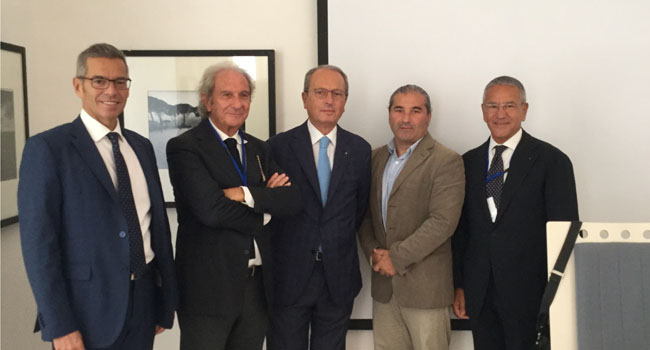
Following the presentation by Ferruccio Ferrigni—Scientific Coordinator of the Ravello Centre’s activities and the conference’s originator—introductory and concluding remarks were delivered by Alfonso Andria, President of the European University Centre for Cultural Heritage (based in Ravello), and Gianluca Silvestrini, Executive Secretary of the European and Mediterranean Major Hazards Agreement at the Council of Europe.
The wide-ranging and detailed debate featured contributions from Ambassador Francesco Caruso, Prof. Maurizio di Stefano (President Emeritus of ICOMOS Italy and the Integrated System for the Valorization of UNESCO Sites in the Campania Region), and Council of Europe consultant Hakan Shearer Demir.
The criteria and methodologies for transforming the protection of cultural landscapes into an effective means of preventing natural disasters and fostering sustainable human development were thus incorporated into the Conference’s final recommendations—drawing on the experience of local stakeholders and endorsed by experts—for submission to decision-making institutions at the local, national, and European levels.
Furthermore, to move from theoretical statements to practical experimentation, the participants urged the European University Centre for Cultural Heritage to formulate a transnational pilot project—potentially involving Greece, Algeria, another country on the southern shore of the Mediterranean, and, for Italy, the Amalfi Coast and Cinque Terre—that would allow for testing the ideas that emerged during the two-day workshop. Through the European and Mediterranean Major Hazards Agreement, the Council of Europe has committed to helping define the project and promoting it among institutions interested in supporting it.