Development plan for archaeological heritage in Mediterranean countries
Tools and methods for cultural policies
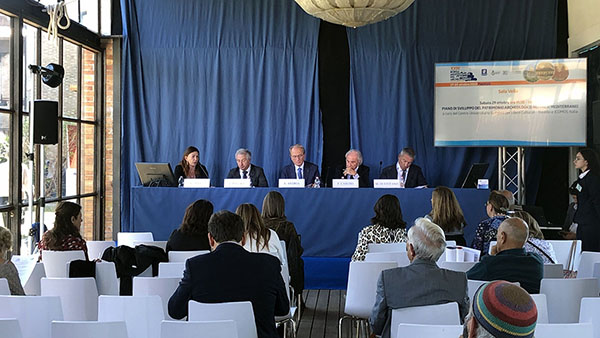
Round table: "Archaeological Heritage Development Plan in Mediterranean Countries"
- October 29, 2022
as part of the 24th Mediterranean Archaeological Tourism Exchange
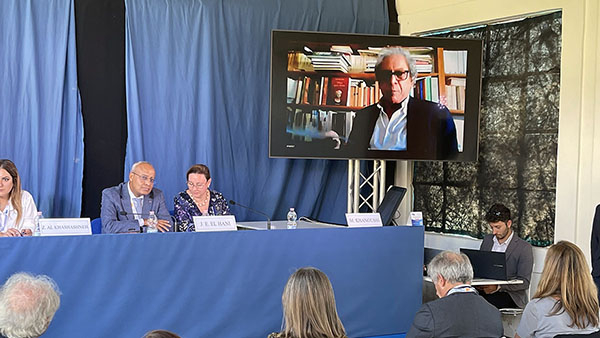
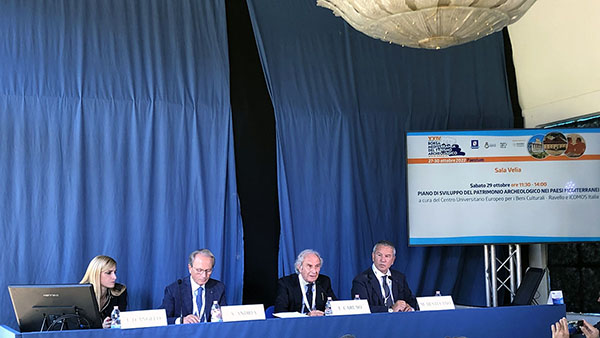
On October 29, participants in the “Archaeological Heritage Development Plan in Mediterranean Countries” project met in Paestum during the 24th Mediterranean Archaeological Tourism Exchange. The event was organized by the European University Centre for Cultural Heritage (CUEBC) and ICOMOS Italy. Partners in attendance included Tunisia’s Ministry of Cultural Affairs, Mohammed V University in Rabat (Morocco), ICOMOS-Jordan, and the Archaeological Park of Pompeii.
Following welcoming remarks by Tiziana D’Angelo, Director of the Archaeological Park of Paestum and Velia, CUEBC President Alfonso Andria opened the proceedings by noting that “for the CUEBC, collaboration with the Mediterranean world is a story that began in the late 1990s with the twinning of Paestum and Volubilis.”
In introducing the project, Ambassador Francesco Caruso cited Fernand Braudel, who as early as the 1940s identified the “Mediterranean world” as a pluralistic, non-homogeneous reality where diverse peoples constantly interact and transform. It is precisely through this plurality that the project aims to offer Mediterranean heritage sites a chance to thrive amidst new global challenges—a goal endorsed by Lazare Eloundou Assomo, Director of the UNESCO World Heritage Centre.
These challenges are well known to the partners who have joined the initiative since its initial presentation at the 2021 Mediterranean Archaeological Tourism Exchange. The various speakers and partners offered many compelling insights, with Jordan, Morocco, and Tunisia stepping into key roles this year.
“Il progetto riprende una strategia già proposta da ICOMOS Italia di intervento sul Mediterraneo che si basa sui principi unescani come pure sull’Agenda 2030. Il progetto adopera la cultura dei siti archeologici per costruire il futuro dei siti stessi” afferma Maurizio Di Stefano.
“The project revives a strategy for the Mediterranean region previously proposed by ICOMOS Italy, based on UNESCO principles as well as the 2030 Agenda. It leverages the culture of archaeological sites to build the future of the sites themselves,” states Maurizio Di Stefano.Il patrimonio archeologico della regione mediterranea è un’opportunità per sintetizzare i valori identitari del Mediterraneo e costituire occasione di sviluppo e interculturalità rappresentata da valori storici e antropologici e da nuovi approcci alla conoscenza e alla consapevolezza condividendo l’articolazione strategica del Piano, nei suoi temi centrali, sintetizzandoli in tre macro aree:
• Definizione di siti e modelli gestionali del patrimonio archeologico;
• Individuazione di percorsi storicamente significativi;
• Potenziamento delle capacità istituzionali e cooperazione interistituzionale e internazionale.
“The selection of locations through which the network will drive development must take into account their potential for economic growth and project success,” concludes Maurizio Di Stefano.
Professor Fabio Pollice, Rector of the University of Salento, notes that the networking of Mediterranean sites—and, looking ahead, their systematic integration—could help extend the scope of the Council of Europe’s Faro Convention to Mediterranean countries, thereby fostering a culture of integration. Culture is, after all, what unites peoples.
Professor Pollice also proposes using the archaeological site as an incubator for activities that engage local communities, facilitating an exchange of knowledge and values among four categories of stakeholders: international, regional, national, and academic.
Architect Anna Onesti of the Pompeii Archaeological Park highlights the importance of continuous maintenance, noting that tourists and local communities alike can contribute to ensuring a creative and sustainable environment.
Architect Onesti is echoed by Dr. Maria Assunta Peci, Director of the International Affairs Office at the Italian Ministry of Culture, who points out that “one cannot conceive of projects in the Mediterranean without a network of cultural sites that facilitates the meeting of identities and fosters joint, peace-oriented action.”
Representatives of the partner countries unanimously declared their firm commitment to the project, outlining their respective areas of collaboration.
“Through this project, we hope to effectively improve site management. Jordan will participate with a focus on heritage conservation, community engagement, and climate change,” says Zeina Al Khashashneh, Project Manager at the Petra Trust.
Moustafa Khanoussi, Advisor to the Tunisian Minister of Cultural Affairs, identifies university education and scientific research as key pillars, alongside cooperation in the field of cultural heritage.
Finally, J.E. El Hani, Dean at Mohammed V University in Rabat, highlights the unique characteristics of the sites proposed for the project—Volubilis, Lixus, and Banasa—and the potential that their environmental enhancement holds for local development. He also discusses how these cultural sites and their appeal to tourists can be integrated into the economic system, serving as a vehicle for the dialogue that the Mediterranean region needs.